
Reviewed · HISTORICAL TOURS
San Francisco Technology and History Tour: South of Market
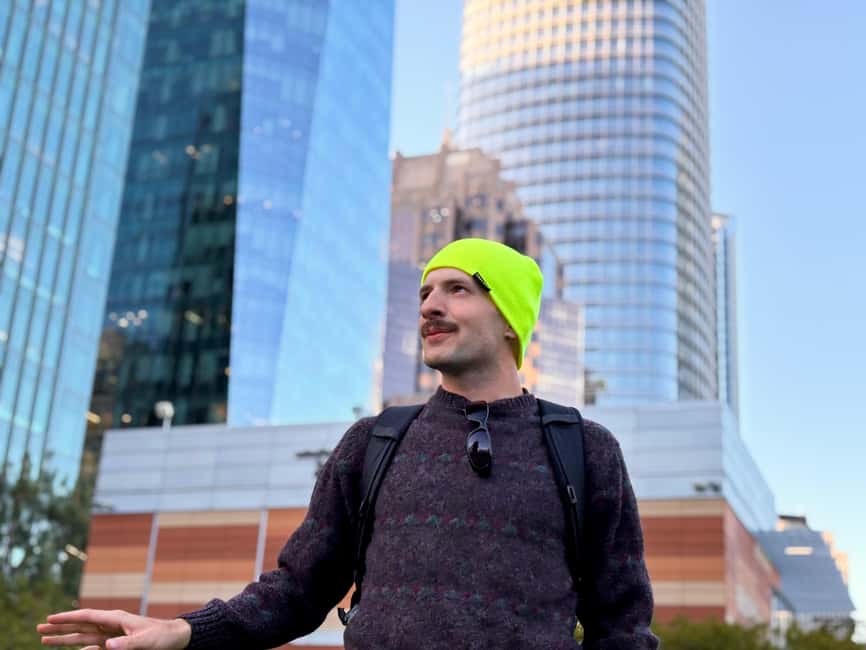
San Francisco’s South of Market neighborhood is where old industry, urban renewal, and modern tech collide. This 70-minute walk with Wes of Heck Wes Tours links South Park, 2nd Street, Yerba Buena Gardens, and Salesforce Park into one clear story. I like the way it connects Instagram and Twitter’s early offices with gold rush camps, shipping docks, and working-class neighborhoods. I also like the rooftop ending, where you can look across the Bay and downtown from Salesforce Park.
The main consideration is pace. You cover several major subjects in just over an hour, so this is a brisk introduction rather than a long, leisurely history walk. You’ll also spend much of the tour on city streets, with traffic, construction, and modern office blocks shaping the experience.
Key points to know before you book
- South Park traces several eras in one small space: gold rush encampment, Gilded Age housing, earthquake refugee camp, Japanese community, industrial district, and tech center.
- Guide Wes works with startups and lives and works in the neighborhood, giving the technology story a direct connection to present-day San Francisco.
- The mostly flat route covers South Park, 2nd Street, Folsom Street, Yerba Buena Gardens, and Salesforce Park.
- Yerba Buena Gardens carries a difficult urban renewal story, including the eviction of people who lived in the area.
- Salesforce Park provides a strong finish, with rooftop views toward the skyline and Bay.
- The tour is wheelchair-accessible, and the route ends near BART and MUNI.
Why SoMa makes such a good history walk
South of Market can look like a wall of offices and wide streets at first glance. Look closer, and you find a neighborhood rebuilt again and again. Its story includes waterfront industry, land reclamation, Japanese settlement, LGBTQ history, poverty, redevelopment, and the rise of venture capital.
That gives Wes plenty to work with. The tour does not treat technology as an isolated success story. Instead, it places the startup economy inside a neighborhood shaped by earlier waves of money, migration, construction, and displacement.
You begin at South Park, at 162 S Park Street. The small oval park was designed in the 1850s after a British garden square. It is one of San Francisco’s oldest neighborhoods, and its calm trees and seating make a useful place to begin.
Wes spends about 10 to 15 minutes here before the group walks north. That opening matters because South Park has changed roles many times. It hosted a gold rush encampment, later became a luxury development during the Gilded Age, and served as a refugee camp after the 1906 earthquake. It also became home to San Francisco’s Japanese community, an industrial population, and eventually a concentration of venture capital and startup offices.
In the 2010s, South Park held the first offices of Instagram and Twitter. Today, it is tied to the financial side of the tech industry. The small park becomes a useful lesson in how quickly San Francisco can change, and how much of the old city remains under the new one.
There is seating and shade in South Park, which helps at the beginning. It is also the most relaxed stop on the route, so you can get your bearings before the walking portion starts.
More history walks in San Francisco:
- Chinatown & North BeachLittle Italy: 7 Tastings & History
★ 5.0 · 1,070 reviews - North Beach & Little Italy Walking Tour: Food, History & Flavor
★ 5.0 · 1,044 reviews - Chinatown Walking Tour: Food, History & Flavor
★ 5.0 · 575 reviews
Walking 2nd Street from shipping route to tech corridor
From South Park, you head north along 2nd Street. The walk is mostly flat, a real advantage in a city famous for steep hills. South of Market is San Francisco’s flattest neighborhood, and this route avoids the demanding climbs found in Nob Hill, Russian Hill, and other well-known districts.
2nd Street is more than a modern office corridor. It historically connected downtown with the docks of the Pacific Mail Steamship Company. That link helped shape the city’s trade and growth, and it makes the street an important piece of San Francisco’s waterfront story.
The street also reflects one of the city’s largest early land reclamation projects. A major hill was flattened to create room for a commercial thoroughfare. As you walk, the modern buildings can hide that dramatic change, which is exactly why the historical explanation adds value. The ground beneath the offices was shaped for commerce long before it was shaped for software.
Today, 2nd Street is associated with LinkedIn, DoorDash, and Anthropic. Those names make the technology theme concrete. You are not simply hearing that San Francisco is a startup center. You are walking past places tied to companies that helped define the city’s current economy.
Wes’s background is particularly useful here. He works with startups and understands the local tech ecosystem from the inside. That lets him explain the business side of San Francisco while still keeping the focus on streets, buildings, and people who came before.
The walk does have a practical limitation. A city street is not a museum gallery, and the route may feel less visually dramatic than a tour built around famous landmarks. The value comes from the connections Wes draws between what you see now and what occupied the same ground before.
Folsom Street and the people behind redevelopment
Folsom Street adds another layer to the route. It is known for its gay history, and its presence helps keep the tour from becoming a simple celebration of technology and new construction.
The neighborhood’s social history is part of the wider story of how SoMa developed. Different communities used these streets at different times, often before the area became attractive to major companies and large property projects. The tour places those communities within the route rather than treating the district as empty space waiting for investment.
That approach is one of the strongest parts of the experience. San Francisco’s new buildings are easy to photograph, but the harder question is what happened to the people who were already here. You get a short but useful introduction to that question before reaching Yerba Buena Gardens.
Because the entire tour lasts 70 minutes, this section cannot cover every detail of Folsom Street’s past. If your main interest is LGBTQ history, you may want a longer, more focused walk elsewhere. Here, the subject works as one part of a larger story about SoMa’s changing identity.
Yerba Buena Gardens and the cost of urban renewal
Yerba Buena Gardens is the tour’s clearest lesson in urban renewal. The gardens are attractive and central, but their creation changed the lives of people who had lived in this part of San Francisco.
Wes discusses the people who were displaced and the effect their eviction had on the city’s political climate. That context gives the gardens more weight. You can enjoy the public space while also understanding that its creation was not a simple improvement with no cost.
This is an important stop for anyone who wants to see San Francisco beyond its polished center. Urban renewal often arrives in the language of parks, culture, offices, and public benefit. The reality can include lost homes, broken communities, and political anger. Yerba Buena Gardens lets you see both sides in one place.
The tour’s use of historical photographs also helps. Comparing older images with the streets in front of you can make changes easier to grasp than a list of dates. You are encouraged to read the present city against its earlier forms.
There is no claim that one short stop can explain every argument over redevelopment. It can, however, give you the basic questions to carry through the rest of San Francisco: Who gained space, who lost it, and how did the city decide what counted as progress?
A different sort of San Francisco day, for when the fog rolls in:
- Muir Woods and Sausalito (Return by Bus or Ferry)
★ 4.5 · 5,098 reviews - Big Bus SF: Hop-on Hop-off Tour with 17 Stops and Sunset Option
★ 4.0 · 4,539 reviews - Napa and Sonoma Wine Country Full-Day Tour from San Francisco
★ 4.5 · 4,455 reviews - Small Group Yosemite and Giant Sequoias Day Trip from San Francisco
★ 5.0 · 3,671 reviews
Salesforce Park, Tar Flat, and the modern skyline
The final stop is Salesforce Park, the rooftop garden above Salesforce Terminal near Salesforce Tower. It is the most visible sign of the tech industry’s recent reach into downtown, and it gives the tour a strong visual finish.
From the rooftop, you can see the city skyline and the Bay. After walking through older streets and discussing vanished neighborhoods, the view shows the scale of current development. Salesforce’s project is the largest recent development in San Francisco, so it makes sense as the endpoint of a tour about money, infrastructure, and changing land use.
The site also has an older story. It was built over a beachfront natural gas refinery and once held Tar Flat, described as the city’s poorest neighborhood. That contrast is striking: a high-profile technology project now occupies ground associated with industrial work and severe poverty.
You also have the chance to see Klockar’s Blacksmith, a reminder of SoMa’s earlier role as a metalworking center. Small details such as this keep the ending tied to the neighborhood’s working past rather than allowing the rooftop view to become only a celebration of new construction.
Salesforce Park is a fitting place to pause, but keep your expectations measured. The skyline view is part of the tour, not a separate observation-deck visit with a long viewing period. The guide’s interpretation remains the point, while the rooftop garden supplies the setting.
How Wes shapes the experience
Wes is the named guide for this experience, and his strongest asset is the mix of local work and historical interest. He lives and works in the neighborhood, works with startups, and brings personal familiarity with the present-day tech community.
That combination matters. A guide who knows only the old history might miss why South Park and 2nd Street matter to today’s companies. A guide focused only on technology might skip the Japanese community, industrial workers, Folsom Street, Tar Flat, or the political effects of urban renewal. Wes connects both sides.
His approach is also personal rather than purely academic. The information is presented with personality, historical photographs, and anecdotes. That helps make a short route feel full without turning it into a lecture.
The available feedback is especially consistent on this point. Every listed rating is five out of five, and the strongest praise focuses on Wes’s passion, warmth, and ability to explain the city’s layered development. Local participants found material they did not already know, which is a good sign for Bay Area residents who assume they have seen all of SoMa.
Still, a short tour can only go so far. You should expect a lively framework and a set of useful connections, not a full course in San Francisco history or the startup economy.
Price, pace, and practical value
At $30 per person, the tour is reasonably priced for a private guide-led city walk lasting 70 minutes. The value is strongest if you want context rather than a list of photo stops. You are paying for the guide’s interpretation of several complicated subjects, including land reclamation, venture capital, shipping, LGBTQ history, redevelopment, and displacement.
The route also ends in a useful place. Salesforce Tower and Salesforce Terminal are near BART and MUNI, and the Powell Street cable car is about a 15-minute walk away. You can easily continue to another part of downtown after the tour instead of spending time finding your way back to the starting point.
The walk is wheelchair-accessible, and the mostly flat streets make it one of the easier ways to explore central San Francisco on foot. You should still wear comfortable shoes and clothes. The route involves city sidewalks and several walking sections, even though it avoids steep hills.
English is the tour language. Private groups are available, which may suit families, colleagues, or friends who want more control over the pace and discussion. Starting times can vary, so check availability when you choose your date.
Free cancellation is available up to 24 hours before the tour, and you can reserve now while paying later. Those terms help if your San Francisco plans are still shifting.
Who should take this SoMa tour?
I would recommend it most strongly to three kinds of people.
First, it suits visitors who have already seen the usual San Francisco sights and want to understand the city’s recent changes. SoMa gives you a different San Francisco from the Golden Gate Bridge, Alcatraz, and cable cars.
Second, it works well for people interested in technology but unwilling to treat the startup world as a separate bubble. You see where major companies began, while also learning what existed before their offices arrived.
Third, it is a good fit for locals. The route covers familiar streets, but Wes’s mix of personal experience and historical photographs can reveal details that are easy to miss during an ordinary commute.
It may be less suitable if you want a slow architectural walk, a food tour, or a long focus on one period. The route moves quickly and covers several themes. Its strength is the connection between those themes.
Should you book this 70-minute walk?
Book it if you want to understand how San Francisco moved from port, refinery, and industrial district to venture capital center and technology capital. The route is flat, the price is fair, and the ending at Salesforce Park gives you a memorable view tied directly to the story.
I especially recommend it for curious repeat visitors and locals. First-time visitors can also take it, but you may want to pair it with a more classic San Francisco tour for the city’s major landmarks.
The best reason to go is Wes’s perspective. He can talk about startups from inside the current tech world while explaining the people and places pushed aside by earlier waves of growth. That balance gives this short walk more substance than a standard office-district stroll.
FAQ
How long does the tour last?
The walking tour lasts 70 minutes.
Where does the tour begin?
The tour begins in South Park at 162 S Park Street. The meeting point may vary depending on the option booked.
Where does the tour end?
It ends at Salesforce Tower, near Salesforce Terminal and Salesforce Park in downtown San Francisco.
What places do you visit?
The route includes South Park, 2nd Street, Folsom Street, Yerba Buena Gardens, and Salesforce Park.
Is the tour wheelchair-accessible?
Yes. The route is wheelchair-accessible, and South of Market is San Francisco’s flattest neighborhood.
What language is the tour conducted in?
The live tour is conducted in English.
Is this a private tour?
A private group option is available.
What happens if I need to cancel?
You can cancel up to 24 hours in advance for a full refund. You can also reserve now and pay later.
Newest San Francisco write-ups
- Filoli House & Garden★ 5.0 · 20 reviews
- Fisherman’s Wharf & Pier 39 Food Tour – Includes Full Meal, 3 hrs★ 5.0 · 9 reviews
- San Francisco Four Peaks Tour★ 4.0 · 4 reviews
- Express San Francisco Layover Tour w Airport Pickup and Dropoff★ 5.0 · 6 reviews
- Napa Valley Wine and Food Tasting Tour from San Francisco★ 5.0 · 7 reviews
- Experience the Thrills of Yosemite: 3-Day Package★ 5.0 · 3 reviews
- Early Bird: Electric Scooter Rental to Golden Gate Bridge★ 5.0 · 6 reviews
- San Francisco Gregangelo Museum – Immersive Kids’ Tour★ 5.0 · 5 reviews
Historical Tours, compared.
Chinatown & North BeachLittle Italy: 7 Tastings & History
Read our review →
North Beach & Little Italy Walking Tour: Food, History & Flavor
Read our review →

San Francisco Whiskey Cocktail Class: Views and City History
Read our review →
Chinatown Food & History Walking Tour – Small Group
Read our review →
Delicious Fun Food and History Tour of North Beach and Beyond!
Read our review →
San Francisco Ghost Hunt: Haunted History Walking Tour
Read our review →Browse the lists this tour appears in