
Reviewed · MISSION DISTRICT TOURS
San Francisco : Mission and Castro districts tour in French
San Francisco’s story comes into sharper focus when you walk through the Castro and Mission districts, two neighborhoods shaped by migration, protest, art, and everyday local life. This French-language tour links LGBT history, Hispanic heritage, Victorian architecture, murals, shops, and one of the city’s best viewpoints.
I like the small group of up to 10 people, which gives the guide room to explain details and answer questions. I also like the clear route from Cafe de Casa to Mission Dolores Park, with the Castro and Mission receiving about 90 minutes each.
The main drawback is simple: this is a three-hour walking tour that runs rain or shine. You should be ready for outdoor walking, and the price does not include drinks or personal purchases.
Key points to know before booking
- Harvey Milk Plaza and the Castro Theatre: Learn how the Castro became America’s first gay neighborhood and see places linked to Harvey Milk.
- Mission Dolores and the Mission murals: Visit San Francisco’s oldest building, then walk through an open-air display of political and community art.
- French-speaking guides such as Jeremy and Lillian: The tour is designed for French speakers, with history, personal stories, and local anecdotes explained in French.
- A small group of no more than 10: This is a more personal setup than a large bus or crowded group walk.
- A finish at Dolores Park: The tour ends with a wide view toward downtown, a fitting finale after several hours among the city streets.
- A map and follow-up email: You receive a map with suggested addresses, plus an email recalling the places visited and including a souvenir photo.
Why these two neighborhoods make a strong San Francisco tour
Many first visits to San Francisco focus on the Golden Gate Bridge, Alcatraz, cable cars, and Fisherman’s Wharf. Those sights matter, but they do not explain how people actually shaped the city.
The Castro and Mission districts offer a different kind of San Francisco. Here, you see neighborhood streets, local storefronts, murals, old homes, community landmarks, and places tied to social change. The tour is useful because it joins those pieces into one story instead of treating each attraction as an isolated photo stop.
The route also has a sensible rhythm. The Castro provides the clearest introduction to LGBT history in San Francisco. The Mission then broadens the picture with Latino culture, street art, historic buildings, independent shops, and residential architecture. You finish above Dolores Park, looking back toward downtown.
At $65 per person, the tour is not the cheapest way to see these neighborhoods. Still, the price is reasonable if you want three hours of guided context in French, a small group, a prepared route, and follow-up material for exploring on your own. You are paying less for admission tickets and more for interpretation, local orientation, and the chance to notice things you might otherwise pass without understanding.
More Mission District food and mural walks:
- Mission District Food Tour: Appetizers, Entrée and Dessert
★ 5.0 · 182 reviews - San Francisco: Mission District Food Tour with 6 Tastings
★ 4.9 · 104 reviews - Mission District Food Tour
★ 5.0 · 69 reviews
Starting near Cafe de Casa and entering the Castro
The tour begins at Cafe de Casa, then moves into the Castro for roughly an hour and a half. You can expect a guided neighborhood walk with time for photos and explanations rather than a quick drive-by visit.
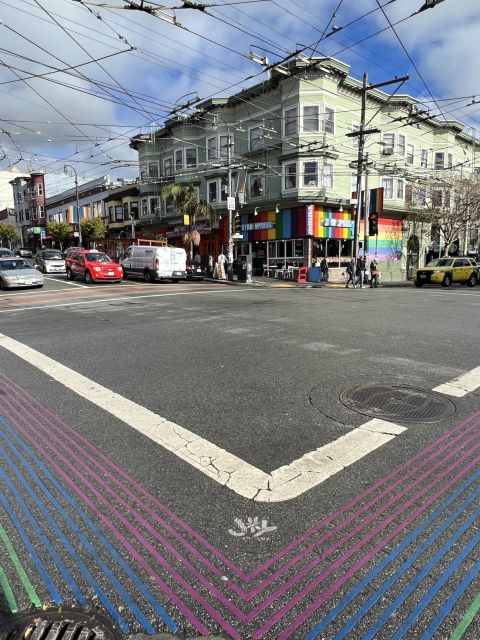
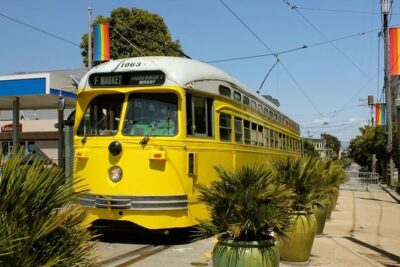
The first unmistakable sign is the giant Rainbow Flag. It is more than a colorful landmark. It tells you that you have entered a neighborhood whose public identity is closely tied to LGBT rights, community life, and political organizing.
At Harvey Milk Plaza, the guide places the neighborhood in its wider social setting. Harvey Milk became the first openly gay elected official in California, and the Castro remains strongly associated with his work and legacy. The tour also points out the former photo store connected with Milk, giving the story a physical address instead of leaving it as a distant chapter in a textbook.
That approach is one of the tour’s strengths. You are not simply told that San Francisco played an important role in LGBT history. You see the streets, storefronts, and civic spaces where that history took place.
The Castro Theatre adds another layer. Its ornate architecture and long connection with neighborhood culture make it an important local landmark, even for visitors who are not especially interested in movie theaters. The tour uses places such as this to show how the Castro developed into one of San Francisco’s most fashionable districts while retaining its political and community identity.
The guide’s storytelling matters here. Jeremy and Lillian are among the French-speaking guides associated with this experience, and the available feedback specifically praises the way the guides combine history, emotion, and anecdotes. That mix should suit you if you want more than dates and names, but still prefer a clear explanation of what you are seeing.
The Castro section: history on ordinary streets
The Castro is not an enclosed museum. You walk through an active neighborhood, so the experience depends on paying attention to street signs, buildings, flags, public spaces, and small details.
That makes the tour feel more like an introduction to city life than a standard monument visit. You may pass places that look ordinary at first, then learn why they matter. A guide can connect a building or plaza to the growth of the LGBT community, political activism, and the Castro’s changing reputation.
This also means the tour will not satisfy someone looking for a long indoor museum visit. Most of the experience takes place outside, and the emphasis is on the neighborhood itself. Wear comfortable shoes, bring protection from sun or rain, and keep your schedule flexible enough to walk at a steady pace.
The limited group size helps. With no more than 10 participants, it should be easier to hear the French commentary and ask about a particular building or event. A large group can make a neighborhood tour feel like a procession. This format is more likely to let you pause when something catches your eye.
Mission Dolores and the oldest building in San Francisco
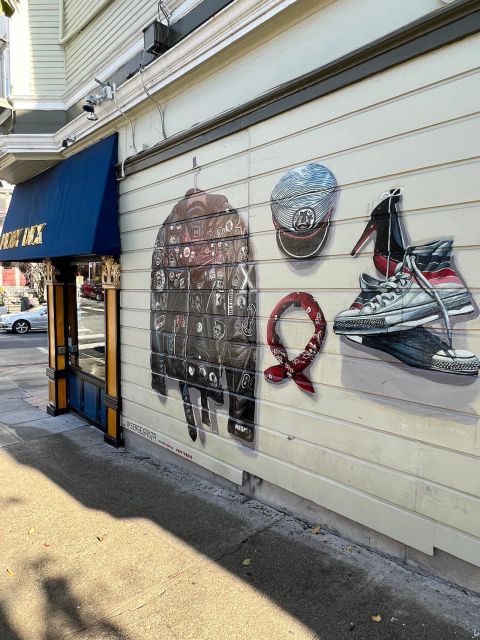
The route then continues toward the Mission District, San Francisco’s oldest Hispanic neighborhood. The change is noticeable in the architecture, street life, food options, and public art.
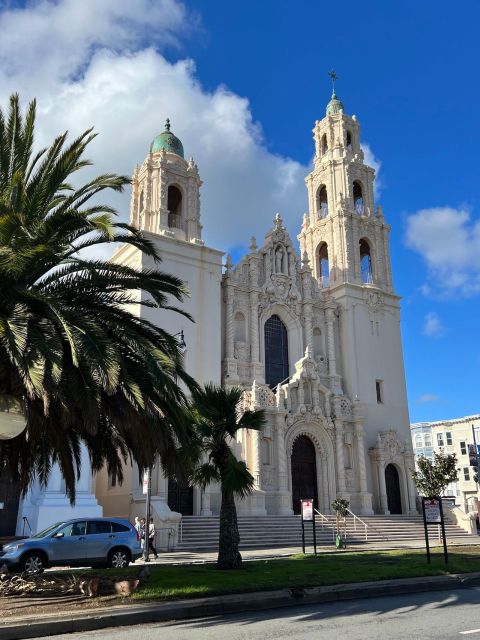
Mission Dolores is the central historic stop. It is identified as the oldest building in San Francisco, making it one of the most important places on the route. Its age gives you a useful anchor before the tour moves into the district’s later layers of immigration, community life, and urban change.
The stop is valuable because the Mission is not only a modern food and shopping district. Its past reaches back to the early Spanish and Mexican period of San Francisco. You do not need to be a specialist in California history to appreciate the contrast between the old mission building and the streets that grew around it.
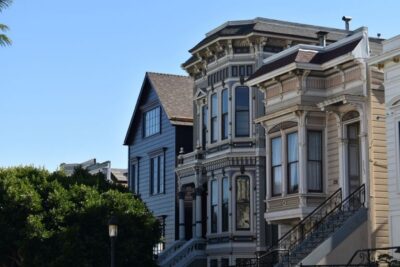
From there, the walk follows Dolores Street, known for its palm trees and attractive homes. This is where the tour brings in the city’s Victorian architecture. You also get the chance to see the famous blue house linked to French singer Maxime Le Forestier’s song. The reference gives French-speaking participants a playful cultural connection to the neighborhood, especially if the song is familiar to you.
Do not expect every house to be treated as a formal museum. The pleasure comes from seeing a collection of homes in their daily setting, with the guide explaining how the residential streets developed and why the architecture matters.
More ways to see the Castro:
- San Francisco Urban Hike: Castro and Twin Peaks
★ 5.0 · 71 reviews - San Francisco Castro Mission Loop Tour
★ 5.0 · 12 reviews - Castro District LGBTQ+ Historic Tour
★ 5.0 · 9 reviews - San Francisco: Castro District LGBTQ+ History Tour
★ 5.0 · 9 reviews
Murals at the Women’s Building and Clarion Alley
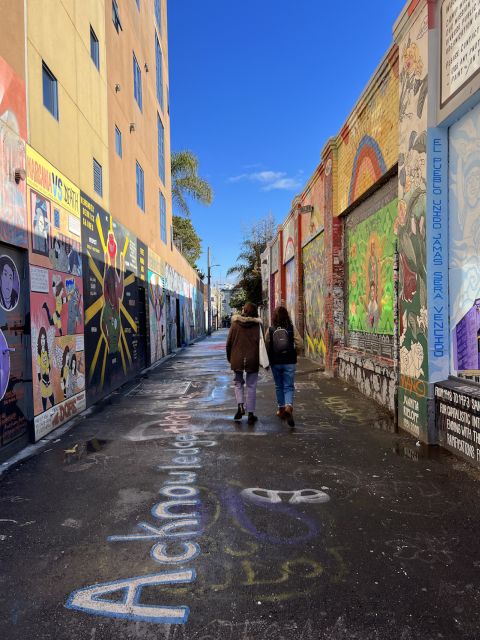
The Mission’s murals are among the most memorable parts of the walk. The tour includes the giant mural at the Women’s Building and the urban art of Clarion Alley.
These works make the district feel like an open-air gallery, but the art is not presented as decoration alone. Murals in the Mission often carry messages about women, immigration, politics, identity, labor, and community life. Their meaning can change as the neighborhood changes, which is why a guide’s explanation adds real value.
Clarion Alley is especially suited to a guided visit because the work is spread through an urban passage rather than arranged in a conventional gallery. You see art in the place where people live and work. You also get a better sense of how San Francisco artists use public walls to make arguments, record events, and claim space.
The murals may be one of the best reasons to choose this tour over a general city sightseeing route. You could seek them out on your own, but the tour gives you a planned route and a French-speaking explanation of what you are looking at.
The art changes over time, so treat the experience as a visit to a living part of the city rather than a fixed collection. That is part of its appeal, but it also means you should not expect every image to remain exactly as described years later.
Valencia Street, local shops, and the useful part of free time
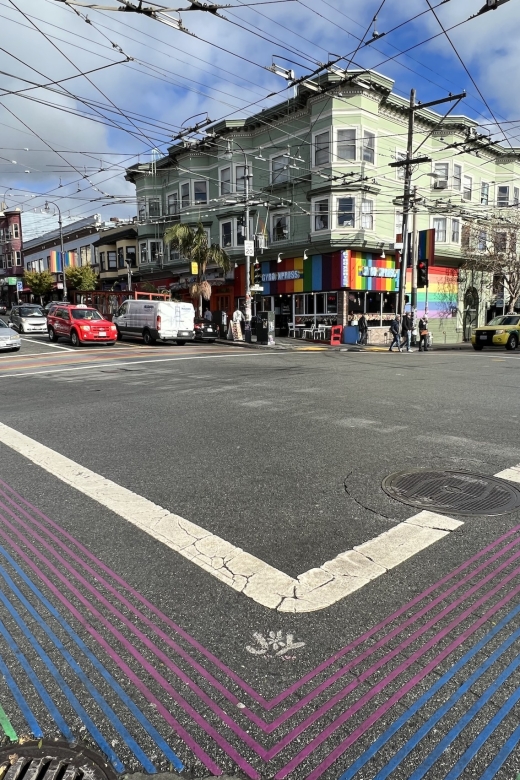
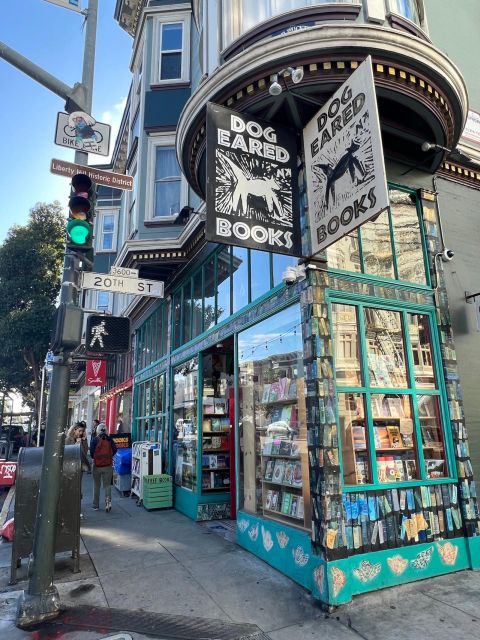
Valencia Street brings the tour into a more commercial and social part of the Mission. Here you find Mexican taquerias, thrift shops, independent bookstores, and unusual local boutiques.
This is a good section for understanding how the neighborhood feels beyond its historic landmarks. Food, shopping, and street art sit close together, and the area gives you practical ideas for returning later. The map provided after the tour includes suggested addresses, so you can use the visit as a scouting trip for a meal or a little independent shopping.
The tour does not include beverages or personal purchases. That is worth remembering because Valencia Street may tempt you to stop for food, coffee, or a small find. Budget extra if you want to turn the walk into a longer afternoon in the Mission.
The guide’s role here is less about pointing to one famous object and more about helping you read the street. You can see how local businesses, food traditions, secondhand stores, and small cultural spaces create a district with a strong personality.
If you have children in your group, this portion may help keep the tour engaging. One French-speaking participant specifically found the visit enjoyable for both adults and children, and the range of murals, shops, homes, and food stops gives the walk more variety than a purely historical route.
Liberty Hill and San Francisco’s Victorian homes
Before the final viewpoint, the tour introduces Liberty Hill, described as San Francisco’s first suburb. This section focuses on the district’s residential architecture, from modest cottages to large Victorian homes.
The John McMullen House is one of the featured examples. It helps show that San Francisco’s historic housing is not limited to the famous painted ladies seen in postcards. The city has many different home styles, sizes, and levels of ornament, often standing side by side.
This part is especially useful if you enjoy architecture but do not want a specialist-only tour. The guide can help you notice features that might blur together when you are walking alone. A simple cottage and an elaborate mansion tell different stories about the people who lived in the area and how the neighborhood grew.
The Liberty Hill section also slows the pace after the murals and commercial streets. You move through quieter residential blocks before finishing in Dolores Park. That change gives the tour a nice shape: civic history in the Castro, historic buildings and art in the Mission, then homes and a broad city view at the end.
Dolores Park: a strong finish with a downtown view
The tour ends at the top of Dolores Park. From there, you get a clear view toward San Francisco’s downtown skyscrapers.
This is a smart finishing point. After spending most of the afternoon at street level, you can look back over the city and place the neighborhoods in relation to the central skyline. The view also gives you time to take photos and let the stories settle.
The tour ends here rather than returning you to Cafe de Casa. That matters for planning. Dolores Park is a useful place to continue your afternoon, but you should make your own arrangements for what comes next. The supplied information does not include transportation after the tour, so do not assume a return transfer.
The park finish also reinforces one of the tour’s main themes: San Francisco is best understood by moving through its neighborhoods, not only by checking off major attractions.
What the $65 price includes
For $65, you receive a three-hour guided walk in French, a group capped at 10, a map of the places visited with recommended addresses, and a follow-up email with a reminder of the route and a souvenir photo.
The map and email are small extras, but they improve the value. You can use the map to return to Valencia Street, revisit a mural, or find a shop you noticed during the walk. The photo gives you a simple record of the experience without asking you to manage every moment through your phone.
The price does not include drinks or shopping, so think of it as the cost of the guided experience only. If you value a French-language guide and want neighborhood history explained in a personal format, the price is fair. If you are comfortable researching the districts yourself and mainly want a self-guided stroll, you may prefer to save the money.
The current rating is 4.6 out of 5 from six ratings, with particularly strong praise for the guides’ French, friendliness, historical explanations, and ability to keep children interested. That is a small sample, but it supports the idea that the human side of the tour is its main asset.
Who should book this French-language walk
I would choose this tour if you want to understand San Francisco through its communities rather than only through famous sights. It suits French-speaking couples, families, and small groups who enjoy walking, architecture, social history, street art, and local shopping.
It is also a good choice early in your stay. The map and neighborhood suggestions can help you decide where to return for food or browsing later. The route gives you useful orientation in two districts that may feel less obvious than the waterfront or downtown.
You should think twice if you dislike walking outdoors for three hours, need frequent indoor breaks, or want a tour focused on major monuments. This is a neighborhood experience, not a bus tour and not a museum visit. It also takes place rain or shine, so check the forecast and dress accordingly.
Free cancellation is available up to 24 hours before the tour for a full refund, and you can reserve now and pay later. Those terms make it easier to fit the walk into a changing San Francisco schedule.
Should you book this tour?
Book it if you want French-language context, a small group, and a thoughtful route through the Castro and Mission. The strongest parts are the combination of LGBT history, Mission murals, Victorian houses, local businesses, and the final Dolores Park view.
Skip it if you only want a short photo stop or prefer to explore entirely on your own. For most French-speaking visitors who want the city explained through real neighborhoods, $65 buys a useful and enjoyable three hours, with enough practical detail to keep exploring after the guide says goodbye.
FAQ
How long does the tour last?
The tour lasts three hours, with approximately one and a half hours in the Castro and one and a half hours in the Mission District.
Where does the tour start?
The meeting point is Cafe de Casa.
Where does the tour finish?
The tour finishes at Mission Dolores Park.
What language is the tour in?
The live tour guide speaks French.
How large is the group?
The group is limited to 10 participants.
What neighborhoods does the tour visit?
The tour visits the Castro and Mission districts of San Francisco.
What is included in the price?
The price includes a French-speaking guide, a map with recommended addresses, and an email after the visit with a reminder of the places visited and a souvenir photo.
Are drinks and shopping included?
No. Beverages and personal purchases are not included.
Can I cancel the tour?
Yes. You can cancel up to 24 hours in advance for a full refund.
Does the tour run in bad weather?
Yes. The tour takes place rain or shine.
Newest San Francisco write-ups
- Filoli House & Garden★ 5.0 · 20 reviews
- Fisherman’s Wharf & Pier 39 Food Tour – Includes Full Meal, 3 hrs★ 5.0 · 9 reviews
- San Francisco Four Peaks Tour★ 4.0 · 4 reviews
- Express San Francisco Layover Tour w Airport Pickup and Dropoff★ 5.0 · 6 reviews
- Napa Valley Wine and Food Tasting Tour from San Francisco★ 5.0 · 7 reviews
- Experience the Thrills of Yosemite: 3-Day Package★ 5.0 · 3 reviews
- Early Bird: Electric Scooter Rental to Golden Gate Bridge★ 5.0 · 6 reviews
- San Francisco Gregangelo Museum – Immersive Kids’ Tour★ 5.0 · 5 reviews
Mission District Tours, compared.

Mission District Food Tour: Appetizers, Entrée and Dessert
Read our review →


Browse the lists this tour appears in